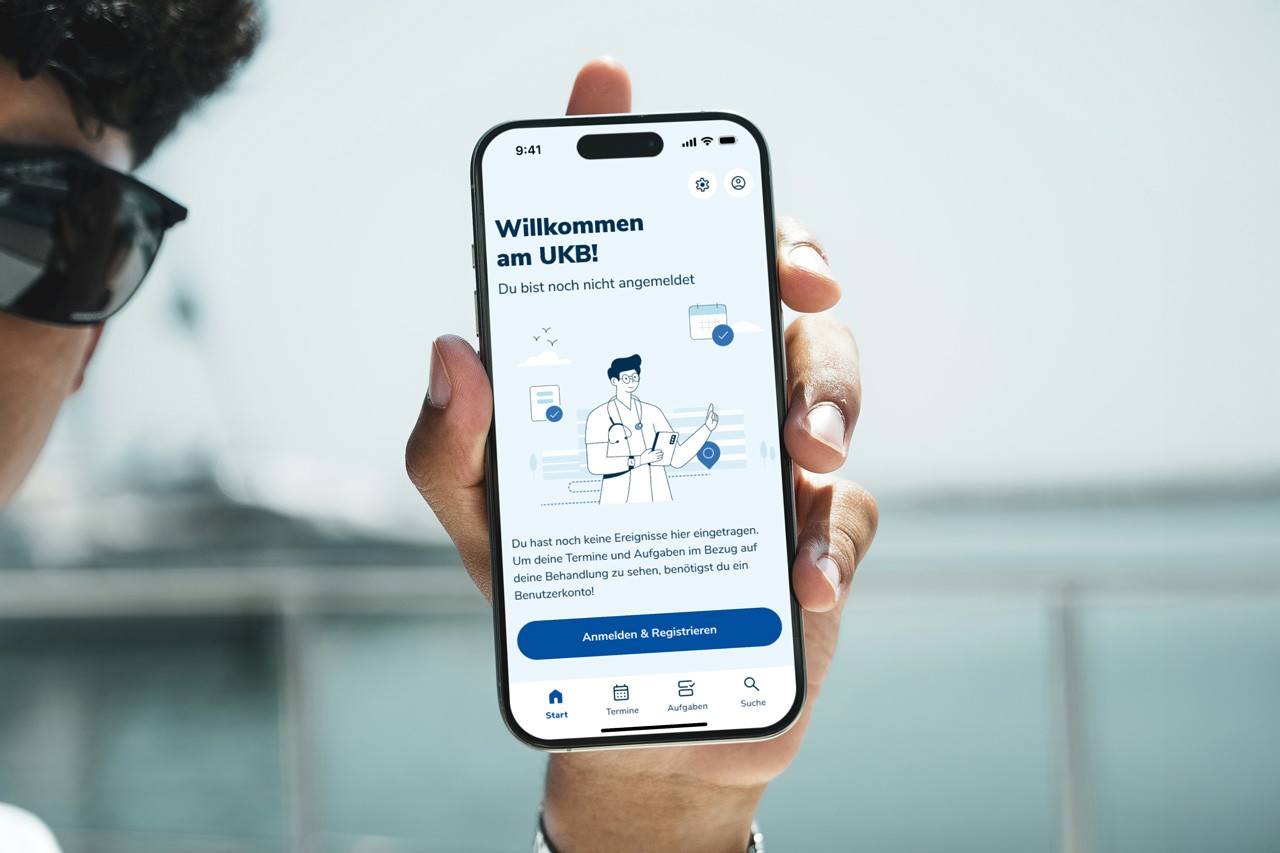
Personal hospital companion for clinical services and treatment support


Position and responsibilities
As Usability Engineering Lead and Art Director, I was responsible for the entire user-centered development process. Based on the contextual studies conducted by the Institute for Digital Medicine at the University Hospital Bonn, I orchestrated the translation of research findings into product strategy, requirements, and design - across a 5-person team of adesso designers and UKB researchers.
In the process, we condensed over 900 unstructured requirements from 7 clinically heterogeneous specialty clinics into 32 main tasks and designed 12 flows with over 200 screens from them. I was responsible for the strategic direction of the requirements process, the design of the patient journey architecture across 4 integrated systems, and the creative leadership from the first wireframe to the WCAG AA-compliant high-fidelity UI.






The Process
The development process followed a five-step approach that systematically aligned clinical stakeholder perspectives with real patient needs.
Step 1: Determine Clinical Context
In a 2-day workshop with UKB stakeholders, the clinical and economic project goals were clarified: What problems in daily clinical operations should the app solve? Which user groups are relevant? Initial assumptions about patient needs were formulated — as hypotheses to be validated in the field.
Step 2: Analyze Usage Context
The assumptions were tested through qualitative field research: 8 focus group discussions with medical staff identified the specific weaknesses in the treatment workflows of individual clinics. 2 workshops and 4 individual interviews with patients — methodologically based on User Story Mapping — captured the actual patient perspective.
Step 3: Validate Patient Journeys
The research findings were visualized as validated patient journeys — separately for outpatient and inpatient treatment paths. From the waiting list through appointment scheduling, the clinic visit, and inpatient admission to discharge and aftercare: Each step was linked to the concrete tasks and questions of patients in their daily clinical experience.
Step 4: Define Core and Sub-Tasks
From 277 collected implied needs, 141 requirements were specified and grouped into 48 core tasks. These were further condensed into 32 main tasks and 120 sub-tasks as the foundation for conceptualization and development. In parallel, validated personas were created for three care scenarios: outpatient, partial inpatient, and inpatient.
Key findings from the analysis phase were the following strategically critical insights:
Clinics are confused during appointment booking: Psychiatry or Psychosomatics? Uncertainty in clinic search created administrative overhead for staff and insecurity among patients.
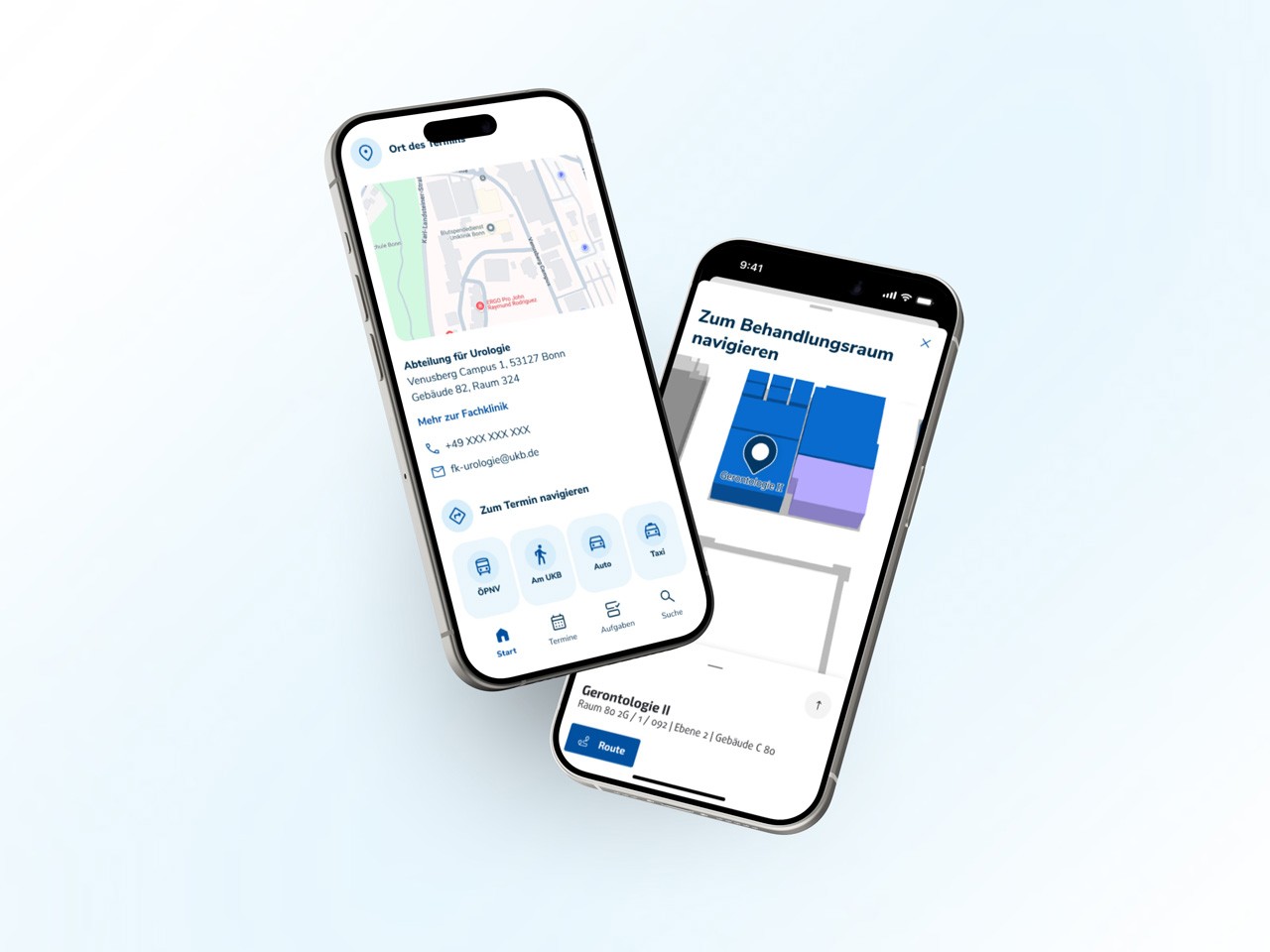
Disorientation on campus: All clinics share the same address, there is no central reception — patients and family members often did not know where to go.
Treatment preparation takes place exclusively on-site: Patients received no information in advance and had no digital way to share documents with their physician.
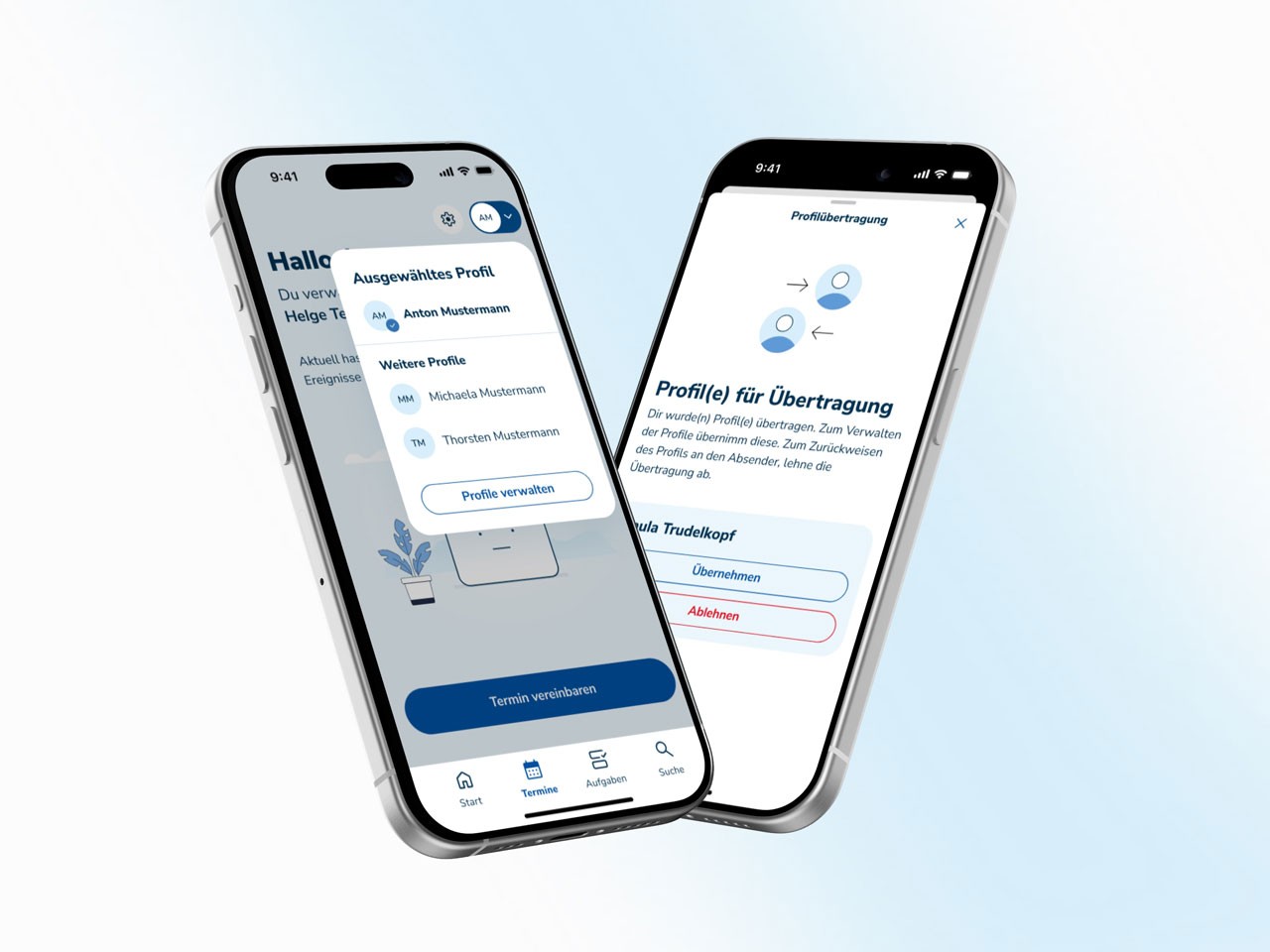
Patients depend on family members: Severe limitations required that family members be able to take over administrative tasks on the patient's behalf.
Patients feel insufficiently informed: Time pressure on staff led to patients and family members perceiving treatment information as inadequate.
Step 5: From Requirements to Solutions
The 5 insights were translated into user-centered system requirements and directly shaped the design decisions: A diagnosis-based search function with visible consultation hours, integrated campus and indoor navigation, digital task management with document upload, family profiles with handover functionality, and structured clinic information pages. Four existing systems — Dedalus, condat, Arivo, and CA — were unified into a continuous patient journey, rather than existing as isolated modules.

Home Dashboard

Appointment management
Family profiles
On-campus Navigation

Task management
Key Details & Numbers
Project duration
4 months
1 month research & analysis
3 months concept & design
Creative Team led
6 designers / consultants
Professional clinics invoved
7
Specified core requirements
32
from 900 user needs
Methods
Requirements Extraction
Reviewed raw patient interview transcripts and workshop notes from six specialized clinics to identify every explicit and implicit requirement mentioned.
Key Task Consolidation
Merged and prioritized tasks across all groups to define 32 core tasks and 120 sub-tasks forming the foundation for the “My UKB” app design.
User Group Categorization
Organized all extracted requirements into groups based on the specific needs of different user types within the hospital ecosystem.
Task Assembly
Clustered related requirements within each user group into coherent tasks, reflecting real-world usage scenarios.
Software Stack
Figma
Confluence
as Quality Management System